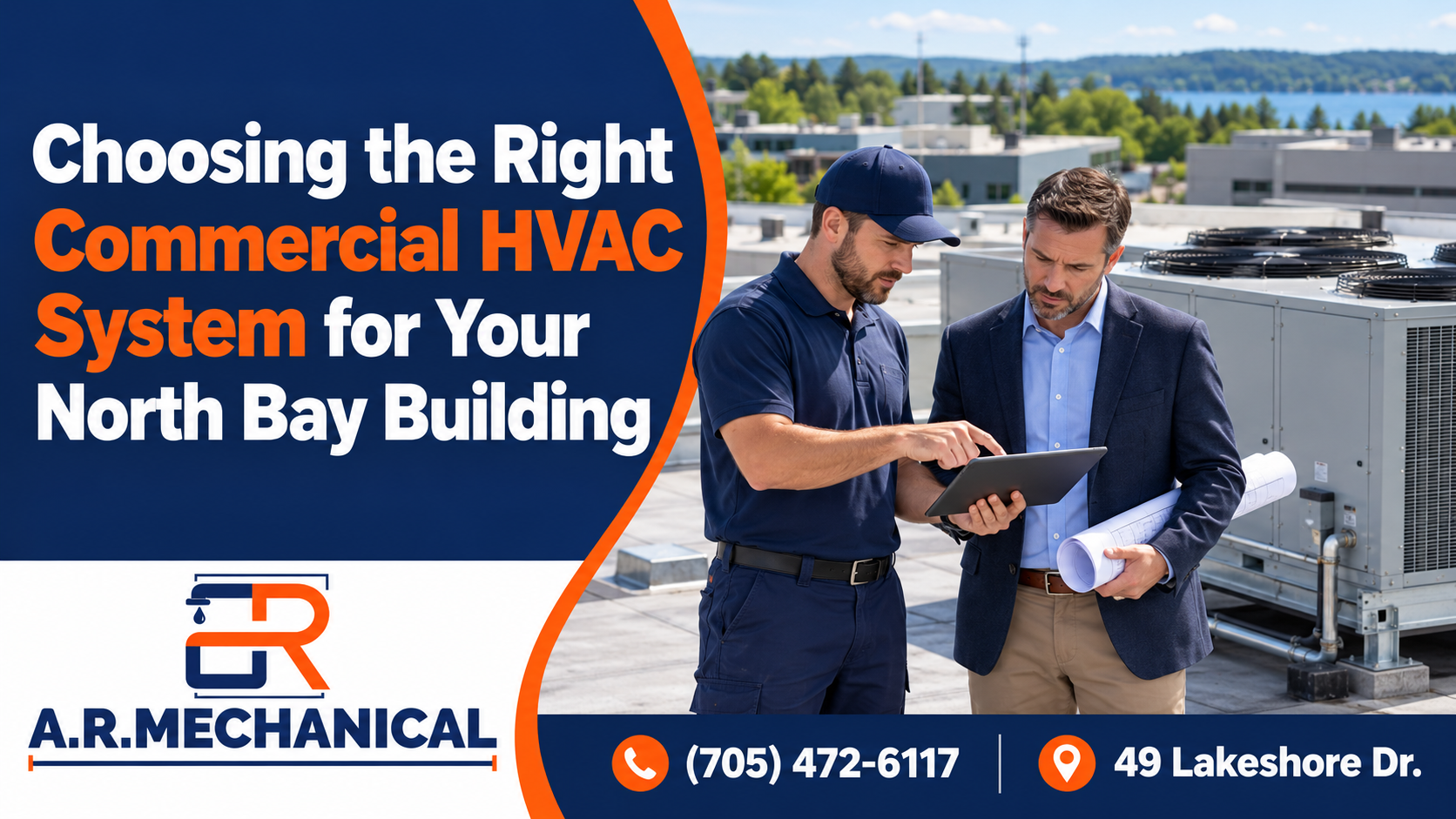
Choosing the Right Commercial HVAC System for Your North Bay Building
Replacing commercial HVAC equipment is a significant decision. The right system keeps staff and customers comfortable, controls energy costs, and matches the way your building is used. The wrong one short-cycles, leaves zones uneven, or costs more to operate than necessary. A.R. Mechanical helps North Bay building owners and managers sort through the options after reviewing the space, existing infrastructure, and actual loads. Here are the main system types and when each tends to fit.
Packaged rooftop units
A packaged rooftop unit combines heating and cooling in one cabinet on the roof and connects to ductwork. These are the most common choice for offices, retail, restaurants, and low-rise commercial buildings in North Bay.
They fit well when:
- The building already has roof access and ductwork.
- You want a single packaged system that is relatively simple to service or replace.
- Heating and cooling loads are moderate and served by one or more standard units.
- You prefer equipment that keeps mechanical components out of occupied space.
Multiple rooftop units can zone a building so different areas maintain different temperatures.
Split systems
A split system places the condenser outside and the air handler or furnace inside, connected by refrigerant lines. These are common in smaller commercial spaces or buildings where a rooftop unit is not practical.
They fit well when:
- Roof structure or access limits rooftop equipment.
- The space is smaller and a single system can handle the load.
- You already have an indoor furnace or air handler that can be paired with a new condenser.
- Indoor equipment location is acceptable.
Commercial heat pumps
Heat pumps provide both heating and cooling from one system by moving heat rather than generating it through combustion. Modern cold-climate models perform better in North Bay winters than older units, though most still include backup heat for extreme cold.
They fit well when:
- You want to reduce or eliminate on-site fuel use.
- Both heating and cooling equipment are due for replacement.
- Electricity rates and building design make operating costs favorable.
- The building does not have economical gas service.
Variable refrigerant flow (VRF) and ductless options
VRF and multi-zone ductless systems allow individual temperature control in many zones from one outdoor unit. They are less common in basic North Bay retail or warehouse spaces but useful in offices with varied occupancy or buildings where running new ductwork is difficult.
They fit well when:
- Different rooms or suites need independent control.
- Adding or replacing ductwork is impractical.
- You are renovating and want flexibility for future layout changes.
Make-up air and ventilation equipment
Buildings with significant exhaust (kitchens, certain retail processes, or high occupancy) often need dedicated make-up air in addition to comfort cooling and heating. This equipment is selected based on exhaust volume rather than just heating and cooling load.
How A.R. Mechanical helps you decide
The correct choice comes from a proper assessment:
- Calculate heating and cooling loads based on the building, insulation, windows, occupancy, and internal gains.
- Review existing ductwork, electrical capacity, roof structure, and fuel availability.
- Consider zoning needs and how different areas of the building are used.
- Compare efficiency, upfront cost, and expected operating cost.
- Factor in maintenance access and long-term serviceability.
A.R. Mechanical’s certified technicians perform this review and explain the trade-offs in plain language before you commit to equipment. The goal is a system that matches your building rather than a default replacement of whatever is already on the roof.
A.R. Mechanical serves commercial buildings across North Bay and the surrounding area with heating, cooling, and ventilation. The team of 11 certified technicians is based at 49 Lakeshore Drive. Call (705) 472-6117 to schedule an assessment and choose the right commercial HVAC system for your building.