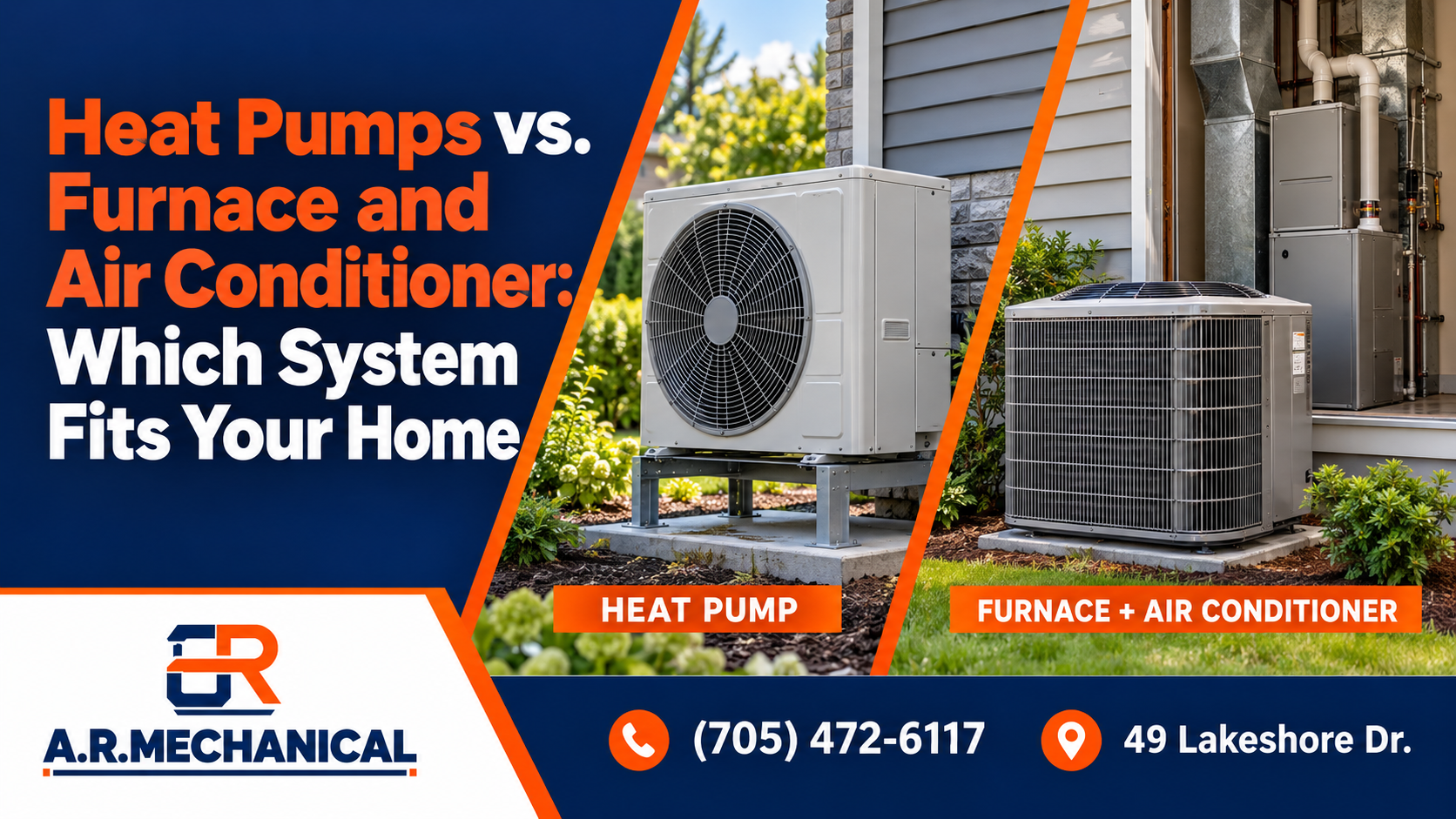
Heat Pump or Furnace and Air Conditioner: Which System Fits Your Home
North Bay homes stay comfortable with either a heat pump that handles both heating and cooling, or a furnace paired with a separate air conditioner. Both approaches work when the equipment is sized and installed correctly. The better choice depends on your house, your fuel options, your existing ducts, and how you want to manage energy use. A.R. Mechanical installs and services both systems and can recommend the right fit after looking at the home.
How a furnace and air conditioner work
A gas or propane furnace heats the house in winter. A separate central air conditioner cools it in summer. The two systems share ductwork and often share the indoor blower, but they are independent pieces of equipment. One fails without taking the other offline.
This setup is often the straightforward choice when:
- The home already has a relatively new, efficient furnace and you only need to replace the air conditioner.
- Natural gas or propane is already connected and priced favorably for your usage.
- You want the highest heat output on the coldest North Bay nights without relying on backup strips.
- You prefer proven, separate systems that technicians everywhere are familiar with.
A high-efficiency furnace still delivers strong heat in extreme cold. The air conditioner is sized only for cooling, so each piece of equipment does one job.
How a heat pump works
A heat pump moves heat rather than creating it by burning fuel. In summer it cools like an air conditioner. In winter it reverses and pulls heat from outdoor air (or the ground, in the case of a geothermal system) and moves it inside. Most North Bay installations are air-source heat pumps. In very cold weather they use electric backup strips or an existing furnace as supplemental heat.
A heat pump is often the better fit when:
- You want one system for both heating and cooling.
- The home has no gas line, or you want to reduce or eliminate fossil-fuel use.
- You are replacing both an old furnace and an old air conditioner at the same time.
- You like the idea of lower operating costs in moderate weather, when the heat pump is most efficient.
- You are adding comfort to a zone and a ductless heat pump solves it without new ductwork.
Modern cold-climate heat pumps maintain useful capacity at temperatures that would have forced older models onto backup heat. They still usually include some form of supplemental heat for the coldest stretches.
Side-by-side comparison
| Factor | Furnace + air conditioner | Heat pump |
|---|---|---|
| Heating fuel | Gas, propane, or oil | Electricity (plus backup) |
| Cooling | Separate air conditioner | Same outdoor unit reverses |
| Cold-weather performance | Strong, consistent output | Very good on modern cold-climate models; backup used in extremes |
| Efficiency in mild weather | Furnace efficiency is steady | Often higher because it moves heat |
| Equipment count | Two systems | One primary system |
| Best for | Homes with existing gas and a good furnace | Homes replacing both systems, or without gas |
| Ductless option | Limited | Common with mini-split heat pumps |
Operating cost and comfort
In moderate fall and spring weather, a heat pump usually costs less to run than a furnace because it is moving heat instead of creating it. On the coldest days the gap narrows or reverses once backup heat engages, depending on electricity and gas rates. Comfort is comparable when both systems are sized correctly. Heat pumps provide steady, even heat; furnaces provide quicker, higher-temperature air. Many homeowners notice little difference once the system is matched to the house.
Noise is low on current equipment in both categories. The main outdoor sound is the condenser or heat pump fan.
Which system A.R. Mechanical usually recommends
- Keep or replace the furnace and add or replace the air conditioner if the furnace is still efficient and gas is already in the home.
- Choose a heat pump if both the furnace and air conditioner are due for replacement, if there is no gas service, or if you want a single high-efficiency system.
- Consider a dual-fuel setup (heat pump with a gas furnace as backup) when you want heat-pump efficiency most of the year and furnace capacity on the coldest nights.
- Look at a ductless heat pump for additions, basements, or rooms the existing ducts never served well.
The right answer comes from a load calculation, a look at the existing equipment and fuel availability, and a clear discussion of operating costs. A.R. Mechanical’s certified technicians do that assessment before recommending equipment.
A.R. Mechanical serves homes and businesses across North Bay and the surrounding area with heating, cooling, and plumbing. The team of 11 certified technicians is based at 49 Lakeshore Drive. Call (705) 472-6117 to book an assessment and find out whether a heat pump or a furnace and air conditioner fits your home.