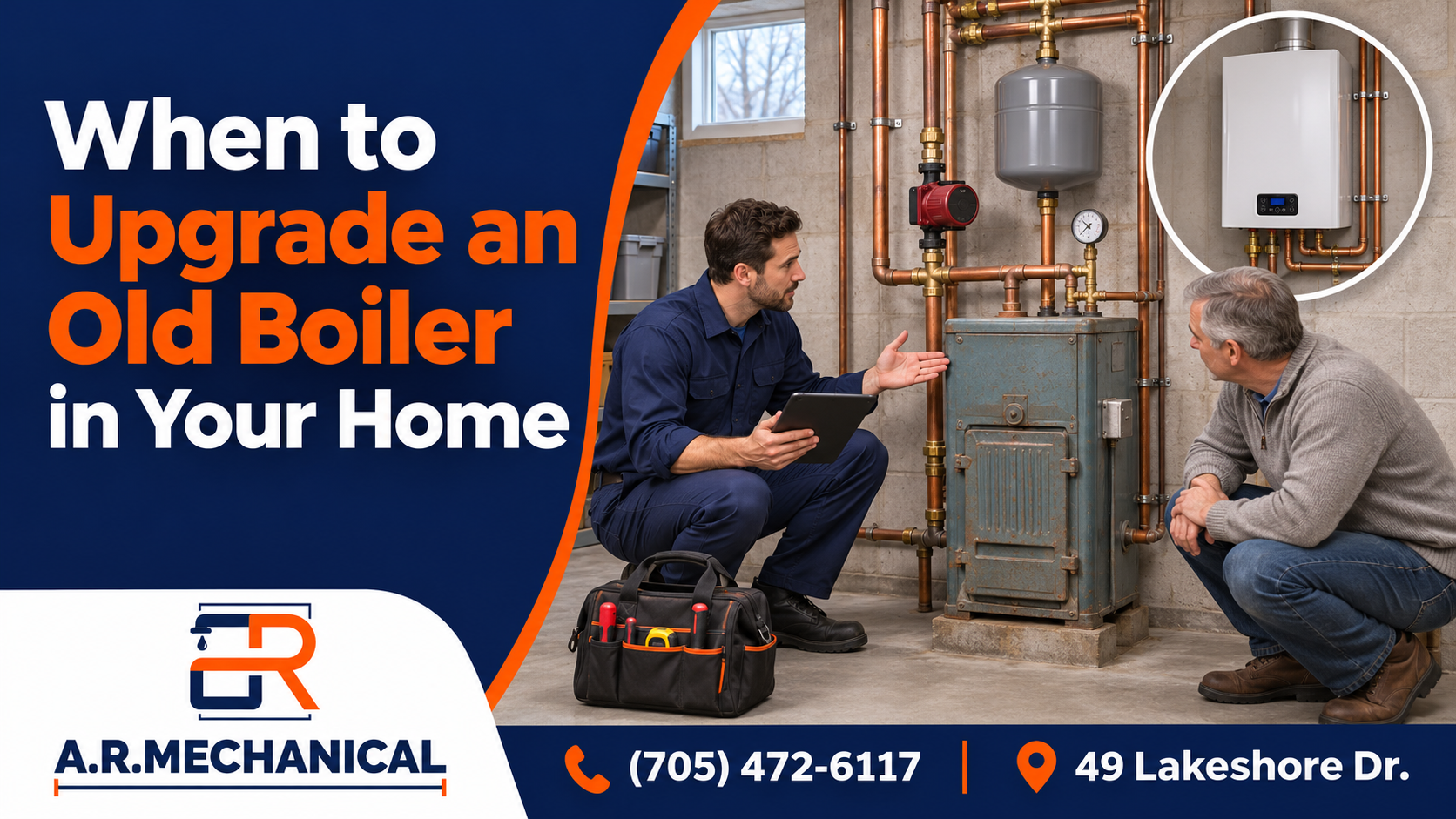
Boilers in Northern Ontario homes often provide reliable heat for 15–20 years or more. At some point, however, continuing to repair an aging unit costs more—in both money and inconvenience—than installing a new high-efficiency boiler. Knowing the right time to upgrade helps you avoid a mid-winter failure and improves comfort and efficiency.
Here’s how to decide whether your boiler should be repaired or replaced.
Age of the Boiler
Most boilers last 15–20 years with regular maintenance. Some last longer; others fail sooner depending on water quality, usage, and care.
- Under 10–12 years: Repair is usually the better choice unless a major component has failed.
- 12–18 years: Evaluate carefully. Frequent repairs or declining efficiency often tip the scale toward replacement.
- 18+ years: Strongly consider upgrading, especially if you’re already facing a significant repair.
If you don’t know the age, the serial number or original installation paperwork can usually provide it.
Frequency and Cost of Repairs
One service call every few years is normal. Multiple repairs in a single heating season—or a repair that costs a large percentage of a new boiler—usually means replacement makes more financial sense.
Ask yourself:
- Have you paid for several repairs in the last two years?
- Is the current repair expensive relative to the boiler’s remaining life?
- Are parts becoming harder to find?
Declining Efficiency and Higher Bills
Older boilers are typically far less efficient than modern condensing models. If your heating costs have risen noticeably while your usage hasn’t changed, the boiler may be losing efficiency due to age, sediment, or worn components. A new high-efficiency boiler can reduce fuel use, though actual savings depend on your home’s insulation, fuel type, and how the system is used.
Comfort and Performance Issues
Signs that the system is no longer keeping up include:
- Uneven heat between rooms or zones
- Slow recovery after the temperature drops
- Short-cycling
- Inability to maintain comfortable temperatures on the coldest days
These problems can sometimes be fixed with repairs or system adjustments. When they persist on an older boiler, replacement often provides more reliable results.
Safety and Condition Concerns
Visible rust, corrosion, soot, or a history of leaks can indicate internal problems. A cracked heat exchanger or serious corrosion is usually a replacement situation rather than a repair. Any safety-related finding should be addressed promptly.
Benefits of Upgrading
A new high-efficiency boiler can offer:
- Lower fuel consumption
- More consistent heat
- Quieter operation
- Modern controls and zoning options
- Improved reliability
- Potential eligibility for rebates (depending on current programs)
In some cases, a combination (combi) boiler can also supply domestic hot water, freeing up space previously used by a separate tank.
Repair vs. Replace: A Practical Approach
A technician will typically look at:
- Age and overall condition
- Cost of the needed repair
- Efficiency of the current unit
- Condition of the distribution system (baseboards, radiators, or radiant floors)
- Your plans for the home
If the boiler is relatively young and the repair is straightforward, fixing it is usually best. If it’s older, inefficient, and facing a costly repair, upgrading is often the smarter long-term decision—especially before the heart of winter.
Planning the Upgrade
The best time to replace a boiler is before it fails completely. Scheduling the work in the fall or during a milder period avoids emergency pricing and ensures you’re not left without heat during a cold snap. A proper installation includes correct sizing, updated controls if needed, and a full system check.
Thinking about upgrading an older boiler in the North Bay area?
AR Mechanical provides boiler assessments, repairs, and high-efficiency replacements for homes and buildings across North Bay and surrounding communities. Call (705) 472-6117 or email admin@ar-mechanical.ca to discuss your system and options.