
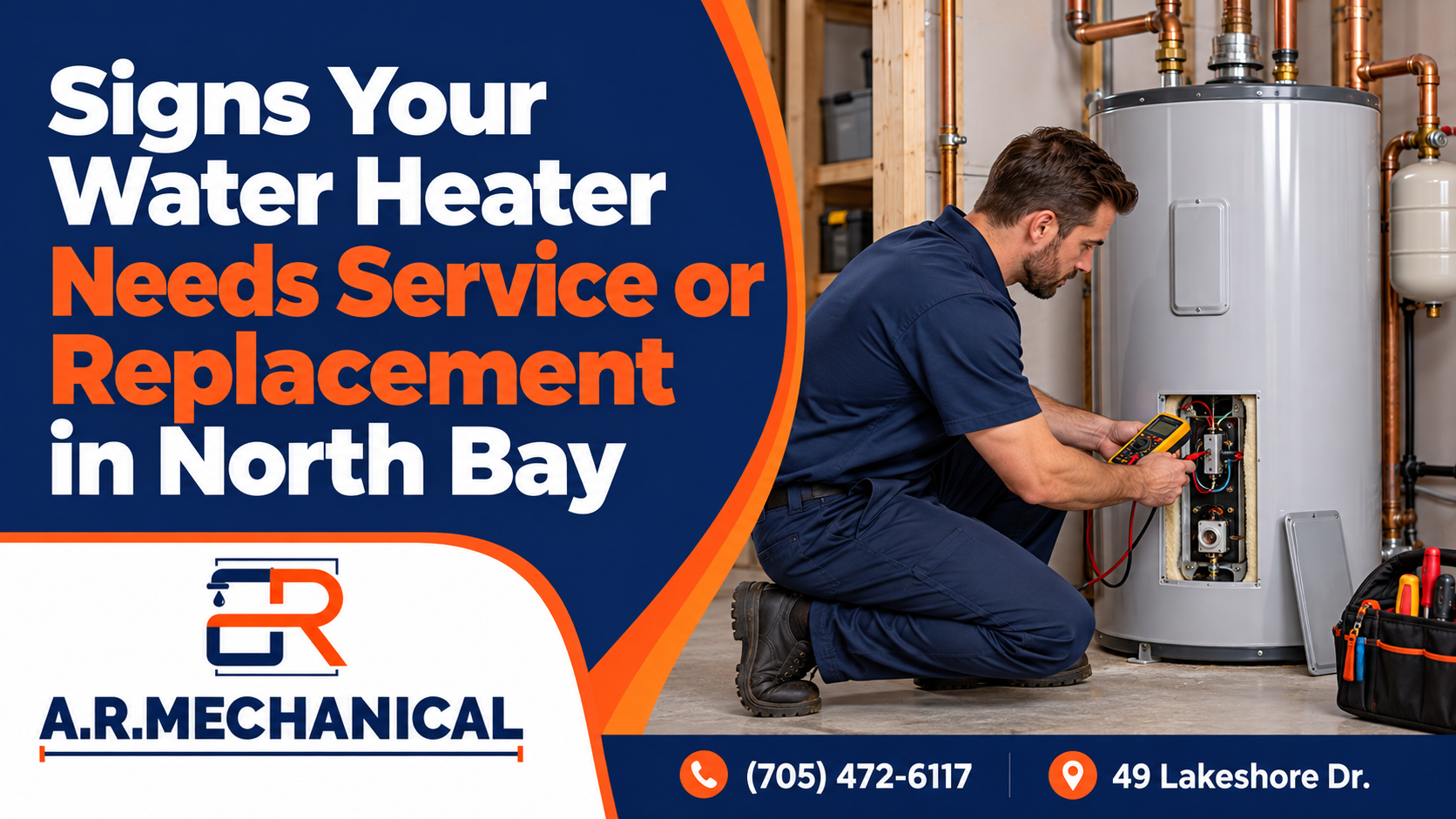
Signs Your Water Heater Needs Service or Replacement in North Bay
A water heater usually gives warning before it leaves you without hot water or leaks across the floor. In North Bay homes, A.R. Mechanical sees the same signs repeatedly. Catching them early means a straightforward repair or a planned replacement instead of an emergency. Here is what to watch for.
No hot water or water that runs out quickly
The most obvious sign. Electric units may have a failed heating element or thermostat. Gas units may have a bad igniter, thermocouple, or gas valve. If the tank is more than 10 years old and you are suddenly getting little or no hot water, replacement is often the better long-term choice. On younger units, a single component repair frequently restores normal operation.
Lukewarm water that never gets hot enough
Water that heats but stays lukewarm can indicate a failing element, a mis-set or failed thermostat, sediment buildup insulating the heat source, or a dip tube that has broken and is mixing cold water at the top of the tank. These are often repairable if the tank itself is sound.
Rumbling, popping, or banging noises
Sediment settles on the bottom of tank water heaters. When the burner or element heats, the sediment causes rumbling or popping. Left alone, it reduces efficiency, stresses the tank, and shortens its life. Flushing can help if the unit is not too old. Persistent noise on an older tank is a reason to plan replacement.
Rusty or discolored hot water
Rusty water from the hot side only usually means the tank is corroding inside. This is a sign the water heater is nearing the end of its life. Anode rod replacement can slow corrosion on newer tanks, but once rust appears in the water, replacement is typically the practical fix. Discolored water can also come from other plumbing issues, so a technician should confirm the source.
Water pooling around the base
Any leak at the tank itself is serious. Small drips from fittings or the temperature-and-pressure relief valve can sometimes be repaired. Water coming from the tank body means the tank has failed and must be replaced. Shut off the water supply to the heater and the power or gas, and call for service before the leak worsens.
Age over 10–12 years with increasing problems
Most tank water heaters last about 8 to 12 years. If yours is in that range and has needed repairs, is noisy, or produces inconsistent hot water, replacement is usually more economical than another fix. Tankless units can last longer but still need service when they scale up or show error codes.
The relief valve discharges regularly
The temperature-and-pressure relief valve should not drip or open during normal operation. Regular discharge can indicate excessive pressure, a failing thermostat, or a valve that needs replacement. This is a safety issue worth addressing promptly.
Higher energy bills
Sediment buildup and failing components make the water heater run longer to produce the same hot water. If energy use has climbed and the unit is older, efficiency loss is another reason to consider replacement with a new high-efficiency tank or tankless model.
What to do next
If you notice any of these signs, schedule service before the unit fails completely. A.R. Mechanical’s certified technicians diagnose the problem, explain whether a repair will restore reliable hot water, and tell you when replacement is the smarter investment. You get a clear recommendation before work begins.
A.R. Mechanical provides water heater repair, maintenance, and replacement along with heating, cooling, and plumbing for homes across North Bay and the surrounding area. The team of 11 certified technicians is based at 49 Lakeshore Drive. Call (705) 472-6117 to schedule water heater service.